Flag Football in Cold Weather Is a Different Game
Quick Answer: Cold weather changes flag football in four specific ways: the ball becomes harder and less grippy, your hands lose fine motor control below about 50°F, muscle strains rise sharply without a longer warm-up, and flag belts behave differently on layered clothing. The fixes are a genuinely longer warm-up, gloves you have actually practiced in, and checking your flag placement over whatever you are wearing.
The first cold league game of the season is always the ugliest. Drops that never happen in August, throws that sail, and someone pulling a hamstring in the first ten minutes.
None of that is coincidence, and most of it is preventable.

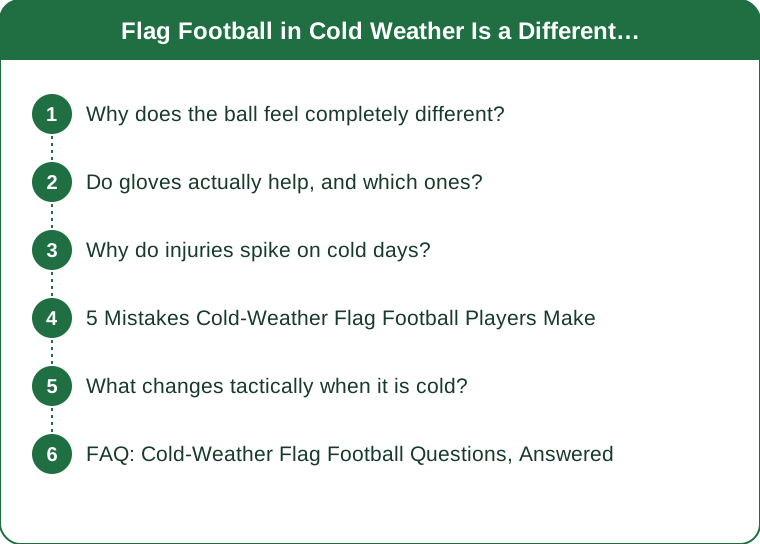
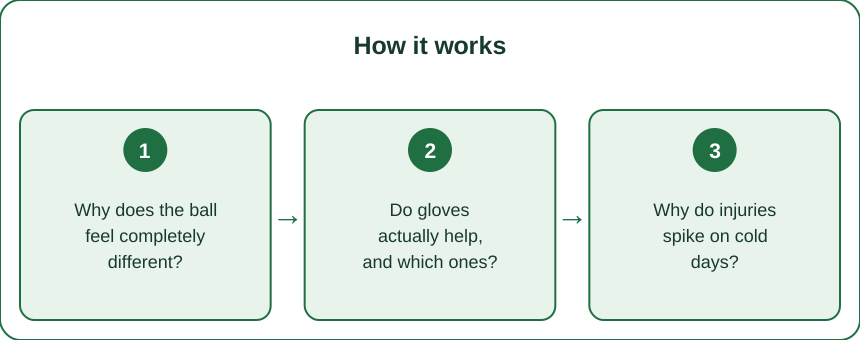
Why does the ball feel completely different?
Because it genuinely is different, and so are your hands.
The ball hardens. Air pressure inside a football drops as the air cools — a ball inflated in a warm car and taken onto a 40°F field loses noticeable pressure. That would make it softer, except that the leather or composite cover also stiffens in the cold, and the stiffening dominates. The result is a ball that feels harder and rebounds more sharply off your hands.
Grip texture changes. Cold, dry air reduces the natural tackiness between skin and ball, and if the ball is damp from dew or frost, that drops further. This is the main reason autumn drops spike — the catch technique is the same, the friction is not.
Your hands lose fine motor control. Below roughly 50°F, blood flow to the extremities reduces and fine motor performance measurably declines. You can still grip hard; what you lose is the fine adjustment that a fingertip catch requires.
What to do:
- Keep the game ball warm between drives if your league allows it. A ball on a cold sideline for twenty minutes is worse than one in a bag.
- Catch with your body more than in summer. Trapping against the chest is not poor technique in 40°F conditions — it is the correct adaptation.
- Keep your hands warm before you need them. Pockets, sleeves over the hands, or hand warmers on the sideline. Once your hands are properly cold, warming them up mid-game takes longer than you have.
Do gloves actually help, and which ones?
Yes, substantially — with one important condition.
Receiver gloves genuinely improve grip in the cold. The tacky palm material maintains its properties far better than skin does in cold dry air, and the difference on a hard, cold ball is not subtle.
The condition: practice in them before you play in them. Gloves change your release on throws and change how the ball feels arriving. A quarterback who has never thrown in gloves will throw badly in them for the first twenty minutes, which is most of a flag football game.
What to look for:
- Tacky palm, thin back. Thickness costs you feel and buys you very little warmth in a receiver glove.
- Snug fit. A loose glove slides on the hand at the moment of catch, which is worse than no glove.
- Keep them clean. Tacky palms lose grip as they collect dirt, and a wipe with a damp cloth restores most of it. Dirty gloves are worse than bare hands, which surprises people.
For quarterbacks specifically: many prefer bare hands with hand warmers on the sideline over gloves, because the release feel matters more than the grip. It is genuinely individual, and the only way to know is to throw both ways in cold conditions before it counts.
Do not wear bulky winter gloves to play. They eliminate the fine control that makes a catch possible, and they are why so many cold-weather drops happen to people who thought they had solved the problem.
Why do injuries spike on cold days?
Because muscle temperature governs muscle behavior, and everyone under-warms up in the cold.
Cold muscle is stiffer and less extensible. A muscle at a lower temperature generates force less efficiently and tolerates rapid lengthening less well — which is exactly what a sprint start or a hard cut demands. Hamstring strains in flag football cluster in the first quarter of cold games for precisely this reason.
The warm-up that worked in August is not enough. In warm weather, ten minutes gets you ready. In 40°F, you need closer to twenty minutes, and you need to stay warm after it — a full warm-up followed by fifteen minutes of standing on a cold sideline puts you back where you started.
A cold-weather warm-up that works:
Minutes 1–6: continuous easy movement — jogging, side shuffles, backpedaling. The goal is genuinely raising core and muscle temperature, and it should take long enough that you would take a layer off.
Minutes 6–12: dynamic mobility — leg swings, walking lunges with rotation, high knees, butt kicks. Full range, controlled.
Minutes 12–18: progressive accelerations. Four to six runs building from 50% to near-full speed. This is the part people skip and it is the part that prevents hamstring strains — the tissue needs to experience high-speed lengthening before the game demands it.
Minutes 18–20: position-specific work. Routes, throws, flag pulls.
Then keep the layers on until you play. A warm-up jacket over your game shirt on the sideline preserves everything you just built.

5 Mistakes Cold-Weather Flag Football Players Make
1. Dressing for standing still, then playing in it. The classic error. You dress for how cold it feels at the coin toss and are overheating by the third drive, which means sweat, which means you get much colder when you stop. Dress so you feel slightly cold during warm-up — you will be right during play.
2. Cotton anywhere in the layer system. Cotton holds sweat against the skin and stops insulating once damp. In cold weather this is not just uncomfortable, it actively accelerates heat loss. A synthetic or merino base layer is the single highest-value cold-weather clothing change.
3. Ignoring where the flag belt sits over layers. Adding a layer changes the belt’s position and how cleanly the flags release. A belt over a slick outer layer rides up and spins, which produces both unfair pulls and missed ones. Set the belt over the layer you will actually play in, snug, and check it after the first drive.
4. Not accounting for the flags themselves. Cold, damp flags stick together and to clothing more than dry ones. If your league uses fabric flags, they will pull less cleanly on a wet 40°F day — worth knowing before you assume a defender got away with something.
5. Skipping hydration because you are not thirsty. Cold weather suppresses thirst and you still lose substantial fluid through breathing and sweat under layers. Dehydration in cold weather is common and rarely noticed, and it degrades performance the same way it does in July.
What changes tactically when it is cold?
More than most teams adjust for.
Deep passing gets less reliable. Cold, dense air adds drag, the harder ball is thrown slightly less accurately, and catch reliability drops. Teams that lean on short and intermediate routes in cold games generally do better, and the ones that keep calling the same deep shots that worked in August generally do not.
Ball security matters more. Every fumble-prone situation gets more fumble-prone. Handoffs, laterals, and contested catches all carry a higher failure rate.
Cuts are less sharp for everyone. Cold turf or frozen ground reduces traction, and cold muscle produces less explosive change of direction. Route running is slower and less crisp on both sides, which tends to favor the offense slightly — defenders have to react, and reaction is what suffers most.
Footwear becomes a real decision. Wet or frosty grass with molded cleats is manageable; the same field with turf shoes is not. Frozen ground is its own category — hard, unforgiving, and less grippy than either. If the field is frozen, shorten your cuts and expect less from your footing.
Games get shorter in effective terms. Everyone tires faster in cold weather because thermoregulation costs energy. Substitution patterns that worked in warm weather leave people gassed in cold ones.
FAQ: Cold-Weather Flag Football Questions, Answered
What temperature is cold enough to change how I prepare?
Around 50°F is where hand function and muscle behavior start to shift noticeably. Below 40°F, treat everything in this article as mandatory rather than optional.
Should I wear long sleeves or is that going to overheat me?
A thin synthetic long-sleeve base under your game shirt is the standard answer and rarely causes overheating during actual play. The overheating problem comes from bulk, not from coverage.
Are there specific stretches for cold weather?
No special stretches — but do dynamic movement rather than long static holds before play. Static stretching a cold muscle is both less effective and less pleasant, and it does not replace the temperature-raising work.
Is playing in the cold actually riskier, or does it just feel that way?
Strain injuries are genuinely more common in cold conditions when warm-up is inadequate. With a full twenty-minute warm-up and layers retained on the sideline, the added risk is much smaller. This is general information, not medical advice.
TL;DR: Cold flag football is a different game and it rewards preparation more than talent.
- The ball hardens and grip drops. Expect more drops, catch with your body more, and keep the ball warm between drives.
- Receiver gloves work — but only if you have practiced in them. Clean palms matter; dirty gloves are worse than bare hands.
- Warm up for twenty minutes, not ten, and include progressive accelerations. That last part is what prevents hamstring strains.
- Keep layers on until you play. A perfect warm-up followed by fifteen cold minutes on the sideline is wasted.
- Check your flag belt over your layers. Adding a layer changes how cleanly flags pull.
- Shorten the passing game. Deep shots are less reliable in cold, dense air with a hard ball.
For your next cold game, arrive twenty-five minutes early instead of ten. That single change prevents most of what goes wrong.
Keep Reading
This article is for general informational and styling purposes only. Fit, sizing, and product availability may vary.