Why the Ball Gets Harder to Catch Once the Evenings Cool
Quick Answer: Drops increase in cold weather for three measurable reasons: reduced hand sensitivity and slower finger response as circulation to the extremities drops, a harder, less compliant ball because the leather stiffens and the internal pressure rises relative to cold air, and wet or dewy surfaces that reduce friction. None of these is a concentration problem. The fixes that actually work are keeping hands warm right up until the play, catching with softer hands rather than firmer ones, and checking ball pressure in cold conditions - a ball inflated in a warm room is over-firm on a cold field.
You caught everything in July. It is now the third week of the autumn season, the evening games are under lights, and balls are going through your hands that you would not have thought about two months ago.
The reflexive conclusion is focus. It almost never is.
Three things about catching genuinely change when the temperature drops, and two of them are about equipment rather than about you.

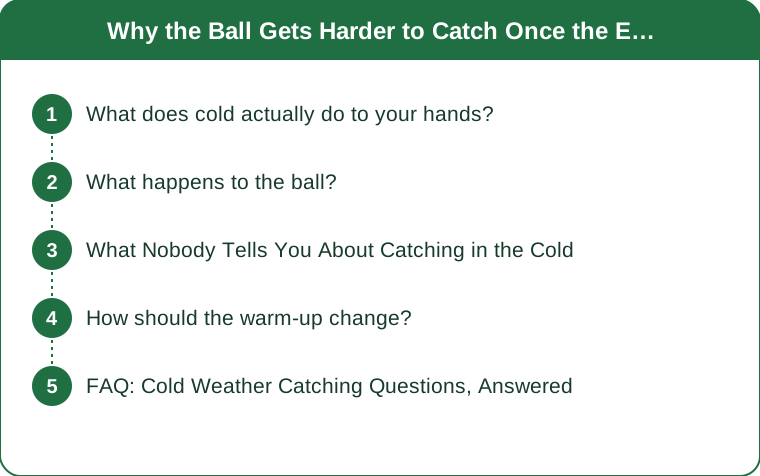
What does cold actually do to your hands?
It reduces sensation, slows your fingers, and stiffens the tissue - in that order of importance.
When ambient temperature drops, the body prioritises core temperature by constricting blood vessels in the extremities. Hands are the first place this happens and the most affected.
The consequences for catching are specific:
Tactile sensitivity drops sharply. Cold skin has measurably reduced two-point discrimination and pressure sensitivity. You get less information about where the ball is in your hands and how hard you are gripping it, which means the fine adjustments that make a catch happen are being made on worse data.
Finger movement slows. Cooled muscle and tendon contract more slowly and with less force. The closing action of the hand around a ball is a fast, coordinated movement, and it degrades before you notice anything.
Tissue stiffens. Tendons and ligaments are less compliant when cold, which reduces the natural give in the hand that absorbs the ball’s impact. A stiff hand transmits more of the ball’s energy back into it, which is why a cold catch stings and why the ball bounces out.
And there is a knock-on effect on technique. Because catching is uncomfortable, people start catching with their body rather than their hands, or reaching with tension. Both produce more drops than the cold itself does.
The practical point: hand temperature at the moment of the catch is what matters, not how warm you were during the warm-up. Standing on a sideline for eight minutes undoes a full warm-up as far as the hands are concerned.
What happens to the ball?
It gets harder, and most people never check.
Air pressure rises relative to the surroundings when the ball is inflated in a warm room and taken into cold air - or more precisely, a ball inflated to the correct pressure in the cold will read higher when brought inside, and one inflated indoors is effectively over-firm outdoors relative to how the leather behaves.
The bigger factor is the leather itself. Cold leather is stiffer and less compliant. A ball that gives slightly under your hands in warm weather deforms less in the cold, which means less contact area, less friction, and a harder impact.
The combination is a ball that behaves like it is over-inflated even when the gauge says it is not.
What to do:
Check pressure in the conditions you are playing in, not in the changing room. A ball checked warm and taken out cold is a different ball.
Keep the game ball warm before use if you can - in a bag, out of the wind, away from wet ground. It makes a genuine difference for the first several plays.
Wet is a separate and larger problem. Dew on autumn evening grass is heavy, and a ball that has been on the ground is slick. Friction between hand and ball is what makes a catch work, and water removes it. Drying the ball between plays is worth more than any technique adjustment.
And a specific autumn hazard: low sun. Early autumn evening games have the sun sitting at exactly the wrong height for large parts of the field. That is a genuine, physical vision problem rather than a focus problem, and the answer is positioning and turning your shoulders to shield rather than trying harder to see.

What Nobody Tells You About Catching in the Cold
Soft hands matter more, not less. The instinct when the ball stings is to grip harder and brace. That is exactly backwards - a firm hand has no give, so the ball rebounds. Catching with slightly relaxed hands and letting them travel back with the ball absorbs the energy. This is standard technique that people abandon precisely when they need it most.
Warm hands right before the play, not before the game. Gloves on the sideline, hands in pockets or under a layer, and a few seconds of vigorous finger movement before you go on. The warm-up you did twenty minutes ago has already left your fingers.
Gloves are worth it, and the type matters. Receiver gloves with a tacky palm compensate directly for both reduced sensitivity and reduced friction. They perform worse when soaking wet, so keeping a dry pair matters more than which brand.
Your first catch of the evening is the worst one. Hand temperature and the tissue stiffness that comes with it need several minutes of activity to normalise. Getting hands on the ball repeatedly during the warm-up - not just running routes - makes a substantial difference to the first quarter.
Dew appears earlier than people expect. On a clear autumn evening, grass can be wet well before dark as the ground radiates heat. A pitch that was dry at kick-off is often slick by the second half, and that is a ball-handling change, not a footing one only.
And the drop that is not about the hands at all: cold reduces the compliance of the whole system, including the shoulders and upper back. Reaching for a high ball with a cold, stiff thoracic spine produces a different arm position than the same reach warm, and it changes where the ball lands in your hands.
How should the warm-up change?
Longer, hands-inclusive, and topped up on the sideline.
Extend the general warm-up. Cold muscle needs longer to reach working temperature, and every part of the standard advice about warm-up duration was written for milder conditions. Fifteen minutes in July is not fifteen minutes in October.
Include the hands and forearms explicitly. Most warm-ups are entirely about legs and general movement. Add wrist circles, finger flexion and extension, and forearm work - and most importantly, catch balls in the warm-up rather than only running.
Do a graduated catching progression. Short soft throws first, then normal, then harder. Going straight to full-speed catches on cold hands is how you get a jammed finger in the first five minutes.
Stay warm on the sideline. A layer that goes on the moment you come off, and hands covered. The single biggest practical difference between players who drop in the cold and players who do not is what they do while not playing.
Re-warm before going back on. Thirty seconds of movement and hand work before you re-enter. It feels unnecessary and it is not.
And plan for the hamstrings, since this is the other cold-weather cost. Hamstring strains rise significantly in cold conditions, and flag football is a sprint-and-cut sport with a lot of maximal acceleration. A proper progressive sprint build-up in the warm-up - not just jogging - is what protects them, and it matters far more in October than it did in July.
General information, not medical advice. Persistent finger, hand or hamstring pain should be assessed rather than played through.
FAQ: Cold Weather Catching Questions, Answered
Do receiver gloves actually help in the cold?
Yes, on two fronts. The tacky palm restores some of the friction that cold and moisture take away, and the covering keeps the hand meaningfully warmer between plays, which addresses the sensitivity problem directly. The main limitation is that most gloves lose grip when saturated, so a dry backup pair is worth more than an expensive single pair on a wet evening.
Should the ball be inflated differently in cold weather?
Check it in the conditions you are playing in rather than adjusting by a formula. A ball inflated indoors and taken into cold air will feel over-firm because the leather stiffens as well as the pressure shifting. Checking on the field, five minutes before play, gives you the number that matters.
Why do my fingers hurt so much more on a cold catch?
Because cold tissue is stiffer and absorbs less of the impact, so more of the ball’s energy goes into the finger joints. It is also easier to jam a finger when your hand is closing more slowly than usual. Warming the hands right before playing, and doing a graduated catching progression rather than starting at full speed, addresses both.
TL;DR:
- Cold hands lose tactile sensitivity, closing speed and tissue compliance - the catch is being made on worse information with a stiffer hand.
- Cold leather is stiffer and the ball plays over-firm. Check pressure on the field, not indoors, and keep the ball dry.
- Soft hands matter more in the cold, not less. Gripping harder makes the ball rebound.
- Warm hands right before the play, not before the game. Sideline layers and gloves do more than any technique cue.
- Catch balls in the warm-up, and build sprints progressively - cold weather is when hamstrings go.
The first catch of the evening is the worst one. Get your hands on the ball before it counts.
Keep Reading
This article is for general informational and styling purposes only. Fit, sizing, and product availability may vary.