Why Your Team Falls Apart in the Last Five Minutes
Quick Answer: Late-game collapses in recreational flag football come mostly from three things: substitution patterns that leave your best defenders gassed, play-calling that gets conservative exactly when it should not, and communication that quietly stops as fatigue rises. All three are fixable without anyone getting fitter.
If your team’s scorelines look competitive through three quarters and lopsided at the end, this is almost certainly why.

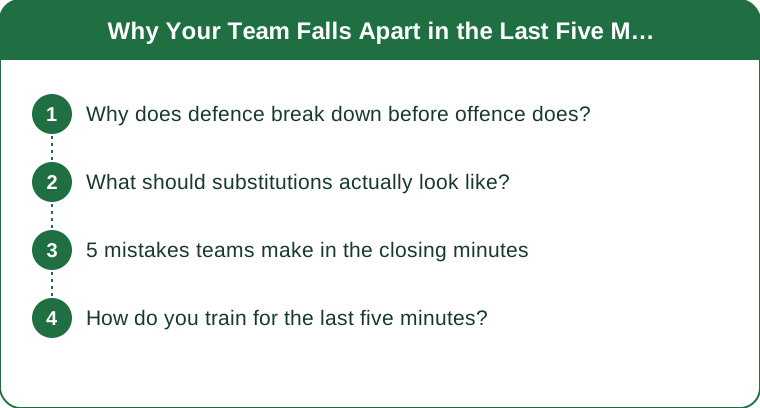
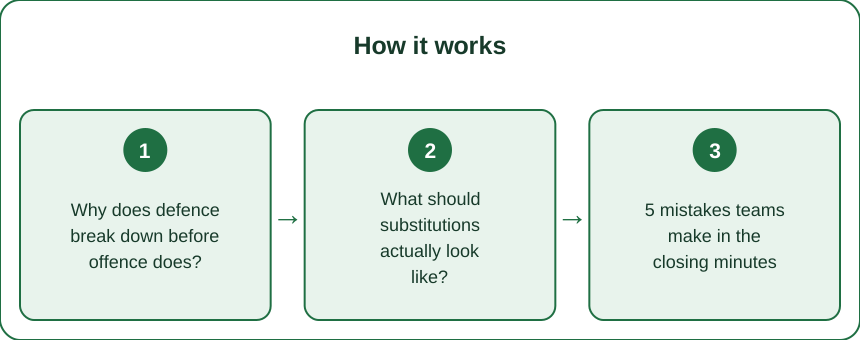
Why does defence break down before offence does?
Defence is reactive, which is more expensive. Every defensive rep involves reading, adjusting, and changing direction based on what someone else does. Offence knows the play. Reacting costs more energy for the same distance covered, and it degrades faster under fatigue.
The best defenders never come off. In recreational teams, the two or three players who cover well play every defensive snap, which means they arrive at the last five minutes with double the workload of everyone else.
Deep coverage fails first. The specific thing that goes is the last few yards of closing speed, which turns a contested throw into a completed one. This is why late-game collapses so often look like a sudden inability to defend the deep ball.
Fatigue shows up as positioning, not effort. Tired defenders play a yard or two off their usual leverage without noticing. Across a whole defence, that adds up to the gaps the other team suddenly starts finding.
What should substitutions actually look like?
Rotate the deep defenders every two possessions, not when they ask. By the time someone asks to come off, they have already played several compromised snaps. A fixed rotation removes the judgement call.
Track possessions, not minutes. Recreational games have wildly variable possession lengths, and a player who has been on for four long drives has done more work than someone on for six short ones.
Keep the rush rotating hardest. Rushing the quarterback is the highest-intensity repeated effort on the field, and it is the role where fatigue most obviously reduces effectiveness.
Save one fresh cover defender for the final two possessions deliberately. Most teams use their bench evenly and arrive at the end with nobody fresh. Holding a rotation slot for the end is a small tactical decision with a large effect.
And make the sub calls before the game. Deciding rotations on the sideline at 5-5 with four minutes left never works — everyone wants to stay on.

5 mistakes teams make in the closing minutes
1. Getting conservative on offence with a small lead. Running the same short play repeatedly with a one-score lead invites the defence to sit on it. The defence is also tired, which is exactly when your deeper concepts have the highest success rate.
2. Stopping the pre-snap communication. As fatigue rises, the talking stops first. Defensive assignments that were called out for three quarters go unspoken, and coverage busts follow within a couple of plays.
3. Calling the same defence every snap. Tired offences are beaten by variety more than by intensity. A single change of look late is worth more than more effort within the same look.
4. Ignoring the clock deliberately. Recreational teams rarely practise clock management, which means the last two minutes are played at the same tempo as the first two. Knowing when to slow down and when to hurry is a free advantage.
5. Leaving the timeout unused. The most common late-game error in recreational flag football is arriving at the final whistle with a timeout in hand. The third mistake here — same defence every snap — is the one that costs the most points, and a timeout is often exactly what buys the conversation to fix it.
How do you train for the last five minutes?
Practise tired, deliberately. Run your two most important offensive concepts at the end of training rather than at the start, after everyone is fatigued. Execution under fatigue is a separate skill from execution when fresh.
Rehearse the two-minute situation. Ten minutes at the end of one training session a fortnight, playing out a one-score game with a running clock. Most teams have never practised it once.
Build repeated sprint ability, not endurance. Flag football is short maximal efforts with incomplete recovery. Training for it means 20-40m sprints with 30-45 second rests, not long steady runs.
Assign a communicator. One player whose explicit job is to call the coverage aloud every snap, including when they are tired. It costs nothing and prevents the most common late collapse.
Hydrate on a schedule during late-summer evening games. Games in the last weeks of August are often played in conditions warm enough to produce meaningful fluid loss, and thirst is a lagging indicator.
TL;DR:
- Defence collapses first because reacting costs more than executing, and your best coverage players never come off.
- Rotate deep defenders and rushers on a fixed possession count, and hold one fresh player for the final two possessions.
- Do not get conservative with a small lead — tired defences are most vulnerable to your deeper concepts.
- Communication stops before legs do; assign someone to call coverage aloud every snap.
- Practise your key plays tired, rehearse a two-minute drill, and train repeated sprints rather than steady running.
The last five minutes are a preparation problem disguised as a fitness problem.
Keep Reading
This article is for general informational and styling purposes only. Fit, sizing, and product availability may vary.