How to Run a Flag Football Practice When Half the Team Shows Up
Quick Answer: A half-attended practice is not a wasted one — it is the best opportunity you get for the individual skills that never fit into a full session. Run a plan built from three blocks that scale to any number: individual technique, two- and three-person combination work, and situational reps that do not need a full defense. Decide the plan before you know the numbers, not after.
You booked the field, you wrote a practice plan for fourteen, and seven people are standing on the grass looking at you.
The instinct is to run a scrimmage anyway with lopsided teams, or to cut it short. Both waste an hour that could be the most useful of the month, because the things that actually lose you games are individual and they never get worked on when everyone is there.

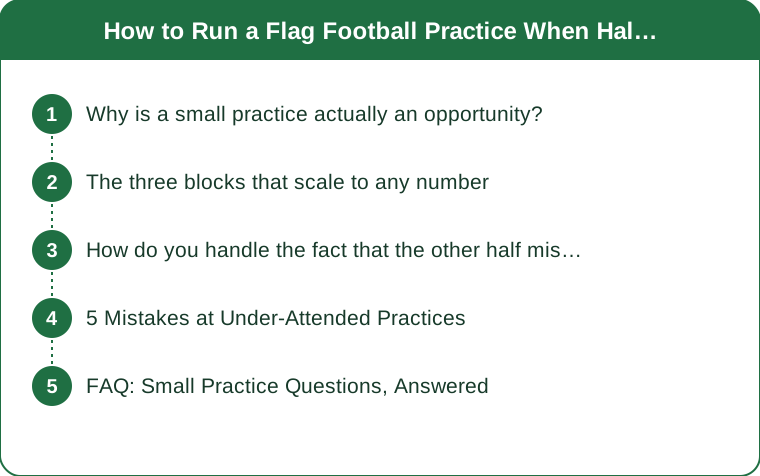
Why is a small practice actually an opportunity?
Because full-team practice is dominated by the things that require a full team, and those are not usually what is costing you.
Think about where points actually go in recreational flag football. Missed flag pulls at the point of contact. Dropped catches on routes that were open. Routes run at the wrong depth. A quarterback who cannot find the second read. Poor angles in pursuit. Every one of those is an individual or two-person skill, and every one of them gets perhaps four repetitions in a full practice because the session is organized around team install.
With six or seven people you can give each player twenty or thirty reps of the thing they are worst at. That is a genuinely different training stimulus and it produces changes you can see in the next game.
There is a second, quieter benefit: the people who show up to the badly attended session are your reliable core, and they are usually the ones who most want to get better. Giving them a good hour is how you keep them, and how the culture of turning up gets built. Cutting the session short teaches exactly the wrong lesson to exactly the wrong people.
The one thing not to do is run a full-field scrimmage with four-on-three. Everyone is out of position, the spacing is nothing like a real game, and it reinforces habits you will spend the next month undoing.
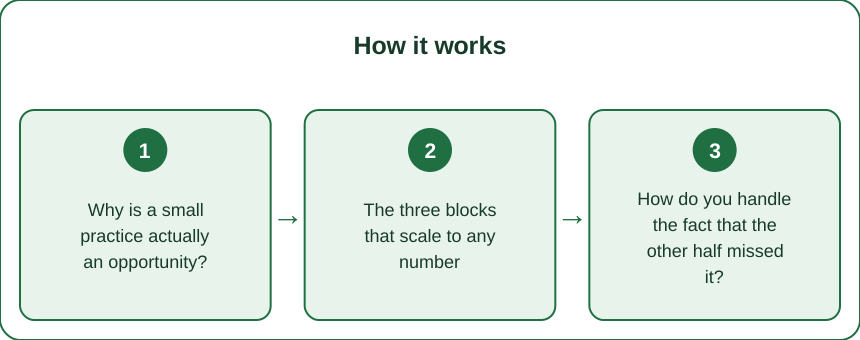
The three blocks that scale to any number
Build every practice from these, and the plan works whether five or fifteen turn up.
Block one: individual technique, 15–20 minutes. No teammates required. Flag-pulling footwork against a cone or a partner walking. Catching — start with the ball and progress: two hands out front, low balls at the shins, over the shoulder, and specifically catching with the non-dominant hand leading. Ball security. Throwing mechanics for anyone who might play quarterback, which in a small session should be everyone.
The one drill worth doing every single time: catching low, moving balls at hip height and below. Almost all dropped passes in recreational play are below the waist, and almost all practice throws are chest-high.
Block two: two- and three-person combination work, 20–25 minutes. A route and a throw. A route, a throw and one defender. Pull-and-shed at a walking pace, then at pace. Two receivers running a combination against one defender, which teaches both spacing and the read.
This block is where small numbers are actually better than large ones, because a three-person drill with seven people has almost no queue.
Block three: constrained situations, 15–20 minutes. Situations that do not need a full defense: goal line from five yards with three attackers and two defenders. Two-minute drill with a running clock. Third and long. Extra-point conversions. The scoreboard-relevant moments of a game are almost all played in a small area with a handful of players anyway, which is why they rehearse well with a small group.
Finish with something competitive and short. People remember the last ten minutes.

How do you handle the fact that the other half missed it?
This is the part that quietly decides whether attendance gets better or worse.
Do not re-teach the whole session next week. Repeating everything for the absentees punishes the people who came and removes any consequence for not coming. It is the single most common mistake a volunteer captain makes.
Send two lines to the group afterwards. What you worked on, and what everyone should know for the game. Not a lecture — two lines. The people who missed it get the information, the people who came get the acknowledgement, and nobody has to sit through it again.
Install team-wide things only when you have numbers. Keep a separate short list of the plays and coverage rules that genuinely need everyone, and run those on the well-attended nights. Trying to install a new zone rotation with six people wastes the install and you will do it again anyway.
Ask why, once, without making it a thing. Recreational attendance falls for structural reasons — the session time stopped working, the field is hard to get to, the season overlapped with school starting. Late August and September are the highest-churn weeks of the year for exactly this reason. A single message asking whether the time still works often fixes more than any amount of encouragement.
And put the number in the ask. Message the group with a request to confirm rather than a general reminder. People respond to a specific question and ignore a broadcast, and knowing the number by the afternoon means you plan the right practice.
5 Mistakes at Under-Attended Practices
1. Waiting. Fifteen minutes of standing around for people who are not coming costs the people who arrived on time. Start at the start time with whoever is there, every time, without commentary. This one habit changes attendance more than anything else.
2. Running a lopsided scrimmage. It teaches bad spacing, it is unbalanced, and the players on the short side spend the whole time out of position. There is no version of four-on-seven that resembles the game.
3. Making it a conditioning session by default. The temptation when you cannot run team work is to run everyone into the ground. It fills the time and it is why some people stop coming. Conditioning belongs in a plan, not in a gap.
4. Skipping the warm-up because it is a small group. Hamstring strains in flag football come overwhelmingly from sprinting cold, and a small practice usually means more sprinting per person, not less. The warm-up matters more, not less.
5. Treating it as a failure. Your tone sets whether the six people who came feel like the committed core or like the leftovers. They came. Run them a good hour — and the fourth mistake on this list is the one most likely to actually injure someone.
FAQ: Small Practice Questions, Answered
What is the minimum number to run a useful practice?
Three. With three you can run every drill in blocks one and two, plus constrained situations. With two you can still do a full technique and throwing session. There is no number at which the answer is go home.
How do I keep it useful if the skill levels are very different?
Pair people deliberately rather than letting them self-select — a stronger player with a newer one on technique work is good for both, because explaining a skill is one of the better ways to consolidate it. In competitive drills, handicap rather than separate.
Should I still charge for or count a half-attended session?
Whatever your club does normally. Changing the rules for a low-attendance night creates the impression that the session was worth less, which is exactly the message you are trying to avoid.
Is late August always this bad for attendance?
For most recreational leagues, yes. Holidays end, school and work schedules reset, and evenings start getting dark. It is worth planning the September session times deliberately rather than assuming the summer slot still works — the fields that were fine at seven in July are dark at seven in late September.
TL;DR:
- A half-attended session is the best chance you get to work individual skills that never fit into a full practice.
- Build every plan from three scalable blocks: technique, two- and three-person combinations, and constrained situations.
- Never run a lopsided scrimmage — it teaches spacing that does not exist in a real game.
- Do not re-teach everything next week; send two lines to the group instead.
- Start on time regardless of numbers, and keep the warm-up in full.
Write one practice plan built from the three blocks and keep it in your phone. Then it does not matter what the number is when you get to the field.
Keep Reading
This article is for general informational and styling purposes only. Fit, sizing, and product availability may vary.