How to Play Both Ways in Flag Football Without Falling Apart
Quick Answer: Playing both ways is limited by repeated-sprint ability, not aerobic fitness, so the fix is managing recovery between accelerations rather than running more distance in training. Take every legal second between plays, position yourself to reduce dead sprinting, front-load your highest-effort routes early in a drive, and train short sprints with incomplete recovery during the week. Most both-ways players fade in the third quarter because they sprinted hard on plays that never came to them.
The skill of playing both ways is deciding which plays deserve full effort, and that decision gets made forty times a game.

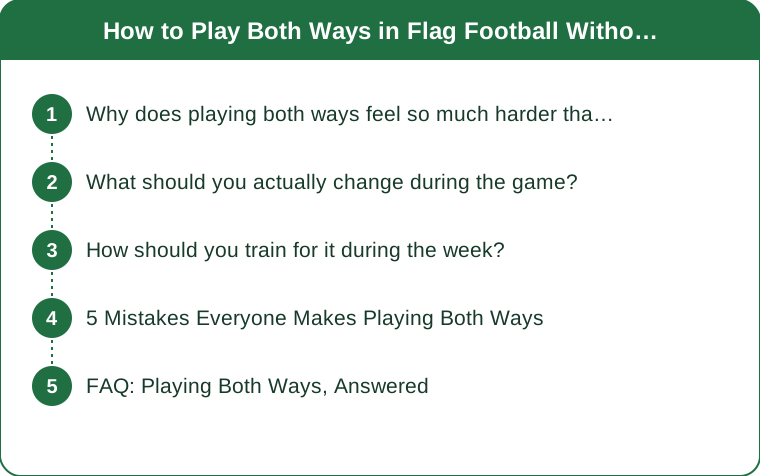
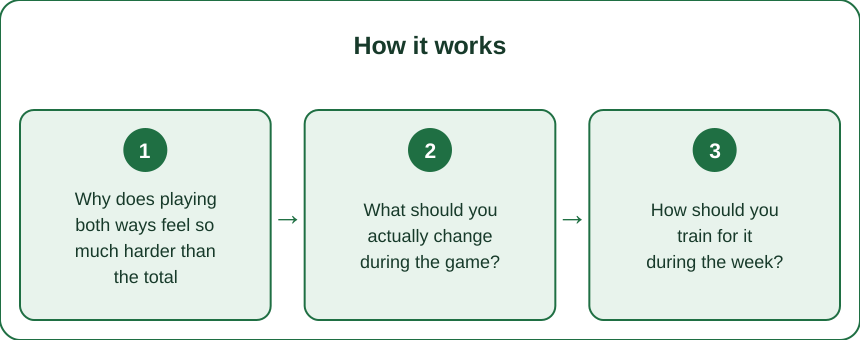
Why does playing both ways feel so much harder than the total distance suggests?
Because flag football is a repeated-sprint sport, and repeated sprints tax a different system than steady running.
Each play is a short maximal or near-maximal effort lasting a handful of seconds, followed by a short incomplete recovery. The energy system that powers those efforts recovers relatively slowly, and it recovers only partially in the time available between plays.
Playing both ways roughly doubles the number of those efforts while the recovery between them stays the same or gets shorter, since you go from the end of a defensive series straight into an offensive one.
Total distance is misleading. You might cover two or three miles in a game, which sounds modest. But the distance is delivered in dozens of accelerations and decelerations, and the deceleration cost in particular is high and largely invisible.
Which is why marathon-style conditioning does not fix it. Aerobic fitness helps you recover between efforts, and it does not make the efforts themselves cheaper.
What should you actually change during the game?
Use every legal second between plays. Walking back to the line slowly, within the rules and the pace of the game, is a legitimate and significant recovery tool. Players who sprint back to the huddle out of enthusiasm are spending effort on nothing.
Hands on knees, not on hips. There is reasonable evidence that a hands-on-knees position with a straight back supports faster recovery breathing than standing upright with hands on the head, which restricts the diaphragm.
Choose your routes. On offense, if you are the third read on a play, you still need to run the route with enough credibility to hold your defender - not at maximum speed. On defense, recognizing a run to the opposite side early saves an entire sprint.
Front-load a drive. Your best efforts should come in the first four or five plays of a series, when the recovery debt is lowest.
Communicate with your team. A one-play breather on a designed run away from you is normal and every experienced both-ways player takes them.

How should you train for it during the week?
Repeated sprints with incomplete recovery is the specific quality you need. A workout of 10 to 12 sprints of 20 to 40 yards with 30 to 45 seconds of rest trains the exact demand, and it is far more transferable than a three-mile run.
Include deceleration. Sprint to a marked line and stop under control rather than coasting through. Deceleration is where hamstring and knee injury risk concentrates, and it is the least trained element in most amateur programs.
Add change of direction. Shuttle runs and cone drills replicate the actual movement pattern better than straight-line work.
Keep some aerobic base work. Twenty to thirty minutes of easy running once or twice a week improves your recovery between efforts even though it does not improve the efforts.
Two quality sessions a week is enough alongside games. Repeated-sprint work is demanding and stacking it produces the fatigue you were trying to avoid.
Do not skip the hamstring work. Eccentric hamstring exercises have solid evidence behind them for reducing strain risk, and hamstring strains are the injury most likely to end a both-ways season.
This is general information, not medical advice.
5 Mistakes Everyone Makes Playing Both Ways
1. Full effort on every route. Forty plays at maximum is not available to anyone. Deciding where the effort goes is the actual skill, and it feels like loafing until you see the fourth quarter difference.
2. Sprinting back to the line. Enthusiasm that costs you recovery. Move at the pace the game requires and no faster.
3. Under-hydrating because the game is only an hour. An hour of repeated sprints in warm weather produces substantial fluid loss, and dehydration degrades repeated-sprint performance measurably. Drink between series, not just at halftime.
4. No real warm-up because you will be running anyway. The first play of the game is a maximal sprint from cold. This is one of the most common injury moments in amateur flag football.
5. Treating the third quarter fade as a conditioning problem. It is usually a pacing and recovery-management problem, and running more miles during the week does not fix it - the second mistake on this list does more damage than most players suspect.
FAQ: Playing Both Ways, Answered
How many plays can a person realistically play both ways?
Most recreational players handle a full game with a small roster, but performance degrades noticeably after roughly 25 to 30 high-effort plays without meaningful rest. If your roster allows even one series off per half, take it.
Should I focus on offense or defense if I am fading?
Defense generally demands more reactive sprinting and less predictable effort, so if you have to conserve, conserve on plays where you are not the primary coverage. On offense you can manage effort within a route more easily.
What should I eat and drink during a game?
Water or an electrolyte drink between series rather than a large amount at halftime. If games run long or back to back, a small amount of easily digestible carbohydrate between games helps more than anything you eat during one.
Is the third-quarter fade avoidable?
Largely, yes - through pacing, recovery position between plays, hydration and picking your efforts. Some fade is normal, but a dramatic drop-off usually reflects effort distribution rather than fitness.
TL;DR:
- Both-ways fatigue is a repeated-sprint problem, not an aerobic one - more distance in training does not fix it.
- Use every legal second between plays, and put hands on knees rather than on your head.
- Decide where your maximum effort goes; forty full-speed plays is not available to anyone.
- Train 20 to 40 yard sprints with 30 to 45 seconds rest, include deceleration and change of direction, and do the eccentric hamstring work.
The players who last four quarters are not the fittest ones on the field. They are the ones who worked out which plays did not need everything.
Keep Reading
This article is for general informational and styling purposes only. Fit, sizing, and product availability may vary.