The Shoulder Injury Flag Football Players Get That Nobody Warns Them About
Quick Answer: Repeated overhand throwing combined with sudden diving or reaching motions for flag pulls creates rotator cuff strain risk in flag football, similar to overuse patterns seen in baseball pitchers but less discussed. A dedicated shoulder warm-up (band work, 8-10 minutes) before games and limiting max-effort throws in practice are the two most effective preventive habits.
Flag football gets framed as low-injury-risk compared to tackle, and for contact injuries that’s true — but the shoulder-specific overuse pattern from throwing and diving flag grabs is a real, separate risk that rarely makes it into safety conversations.

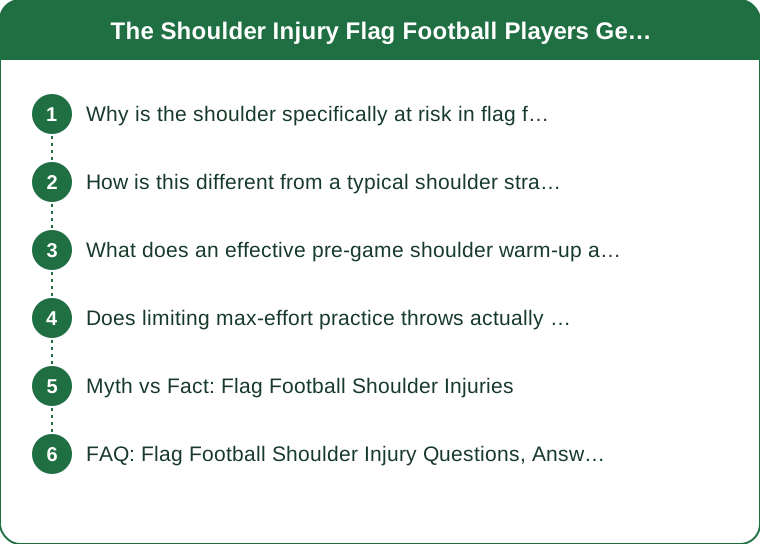
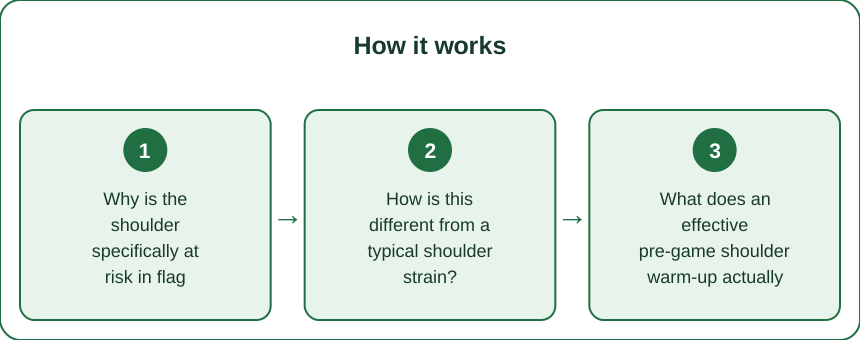
Why is the shoulder specifically at risk in flag football?
The overhand throwing motion repeated across a season, combined with sudden extended-arm reaches during flag pulls and dives, stresses the rotator cuff in a pattern similar to overuse injuries in throwing sports — except flag football players rarely get the same shoulder-conditioning attention that dedicated throwing athletes do.
How is this different from a typical shoulder strain?
It’s usually a gradual overuse pattern rather than a single acute injury — soreness builds across a season of repeated throws and grabs rather than appearing suddenly from one play, which is part of why it goes unaddressed until it’s already fairly developed.
What does an effective pre-game shoulder warm-up actually include?
Resistance band external rotation work, arm circles, and a few reps of light overhand throwing motion before full-speed play — roughly 8-10 minutes focused specifically on rotator cuff activation, distinct from the general body warm-up most teams already do.

Does limiting max-effort practice throws actually reduce injury risk?
Yes, this is one of the more consistently supported prevention strategies — capping high-velocity practice throws and saving max effort for games reduces the cumulative overuse load on the rotator cuff across a season without meaningfully affecting game performance.
Myth vs Fact: Flag Football Shoulder Injuries
Myth: Flag football is essentially injury-risk-free since there’s no tackling. Fact: Contact injury risk is lower, but overuse injury risk (particularly shoulder) from throwing and diving motions is a real, separate category.
Myth: Only quarterbacks need to worry about shoulder overuse. Fact: Diving for flag pulls and reaching motions put defensive players at risk too, not just the position doing the most throwing.
Myth: Shoulder soreness after a game is just normal and doesn’t need attention. Fact: Persistent, building soreness across a season is a warning sign worth addressing with a proper warm-up routine or a professional, not something to just play through.
FAQ: Flag Football Shoulder Injury Questions, Answered
How do I know if shoulder soreness is normal fatigue versus a developing injury?
Soreness that resolves within a day or two after rest is more likely normal fatigue; soreness that persists or worsens across multiple games is worth having checked by a professional.
Are there specific stretches that help beyond the warm-up routine?
Sleeper stretches and cross-body shoulder stretches, done consistently after games (not just before), support recovery and are commonly recommended alongside the pre-game warm-up.
Does age affect this injury risk in flag football?
Rotator cuff tissue becomes somewhat less resilient with age, so players over 35-40 may want to be more consistent with warm-up and recovery habits than younger players. This is general information, not medical advice.
TL;DR:
- Flag football’s throwing and diving motions create real rotator cuff overuse risk, distinct from tackle-injury risk
- It’s usually a gradual overuse pattern building across a season, not one sudden injury
- An 8-10 minute dedicated shoulder warm-up before games meaningfully reduces risk
- Limiting max-effort practice throws is one of the more supported prevention strategies
Flag football’s lower contact risk is real, but the shoulder deserves its own attention separate from that reputation.
Keep Reading
This article is for general informational and styling purposes only. Fit, sizing, and product availability may vary.