The Conditioning Flag Football Actually Requires (It's Not What You Think)
Quick Answer: Flag football demands repeated short sprints (5-15 yards) with 20-40 seconds of rest, not steady-state endurance — train with sprint intervals and lateral agility drills, not long-distance running.
People assume flag football is a casual backyard sport with light cardio demands. Then they play their first real league game and are gasping by the second quarter. The mismatch is almost always training the wrong energy system.

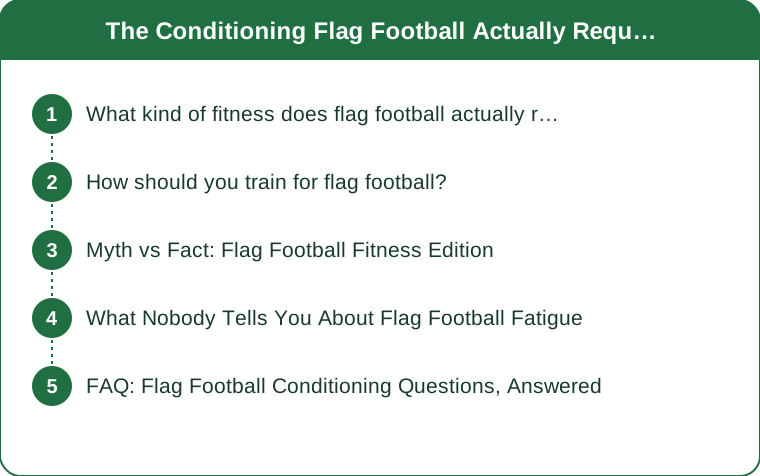
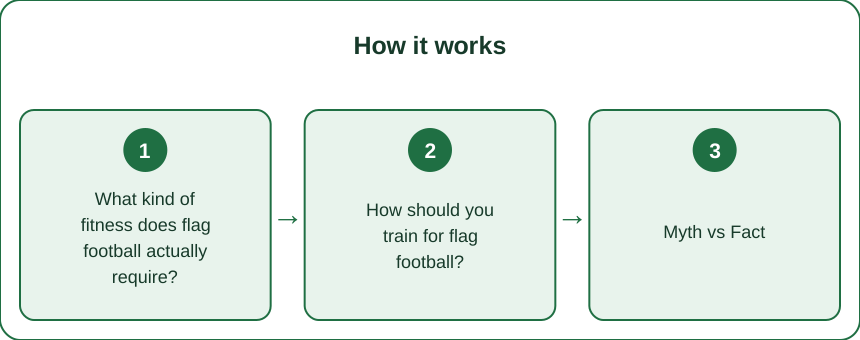
What kind of fitness does flag football actually require?
Short, repeated sprints with quick direction changes — think 5-15 yard bursts, not 400m repeats. A typical play lasts 4-8 seconds, followed by 25-40 seconds to reset.
This makes flag football an anaerobic-alactic and lactic sport, closer in demand to tennis or basketball than to distance running, even though total game time runs 60-90 minutes.
How should you train for flag football?
Sprint intervals, not jogging. A useful weekly template:
- 2x/week: 8-10 sprints of 10-20 yards, full recovery (60-90 seconds) between
- 1x/week: lateral agility — ladder drills, cone shuffles, backpedal-to-sprint transitions
- 1x/week: general conditioning circuit (bodyweight strength + short sprint finishers)
Skip the steady 30-minute jog — it trains a different system than the one flag football uses on the field.

Myth vs Fact: Flag Football Fitness Edition
Myth: Flag football is low-impact, so conditioning doesn’t matter much. Fact: No blocking or tackling doesn’t mean low intensity — receivers and defenders hit near-max sprint speed on nearly every play, which is genuinely demanding conditioning.
Myth: Distance running builds the cardio you need. Fact: Distance running builds aerobic base but does little for the repeated-sprint recovery ability that decides whether you’re still fast in the 4th quarter.
What Nobody Tells You About Flag Football Fatigue
The fatigue that ends most people’s good games isn’t cardio — it’s hip flexor and hamstring fatigue from repeated acceleration and deceleration, not lung burn.
A dynamic warm-up focused on hip mobility (leg swings, walking lunges, high knees) does more for late-game speed than any amount of extra cardio. Most recreational players skip warm-up entirely and wonder why their sprint speed falls off a cliff in the second half.
FAQ: Flag Football Conditioning Questions, Answered
How many days a week should I train for flag football?
3-4 days covering sprints, agility, and strength is enough for a recreational league; more than that risks overuse without much extra benefit.
Do I need to run long distances to prepare?
No — a light aerobic base helps recovery between games, but sprint intervals matter far more for on-field performance.
What’s the single best exercise to add for flag football?
Lateral bound-and-stick drills — they train the exact deceleration-and-cut pattern that decides most 1-on-1 matchups on the field.
TL;DR:
- Flag football is repeated short sprints, not endurance — train accordingly
- 2 sprint sessions + 1 agility session + 1 conditioning circuit per week
- Distance running builds the wrong energy system for this sport
- Warm up hips and hamstrings — that’s what actually decays late in games
Train like a sprinter who rests, not a jogger who sometimes sprints, and the gap between quarter one and quarter four disappears.
Keep Reading
This article is for general informational and styling purposes only. Fit, sizing, and product availability may vary.