Almost Every Rec Flag Football Argument Comes Down to the Same 3 Rules
Quick Answer: Three rules cause the overwhelming majority of rec flag football arguments: flag guarding (using your hand, arm, or the ball to block a defender from your flag), screening versus blocking (you may obstruct with your body but not initiate contact or extend your arms), and the rush line (defenders must start a set distance off the line and cannot cross early). All three are judgement calls, all three vary between rule sets, and all three get called differently by whoever is holding the whistle. Read your league’s rule sheet once before week one and you will win arguments you currently lose.
The fun part of a rec league is that nobody is a professional. The frustrating part is that nobody is a referee either.
Here is what is actually in dispute, and how to be the person who is right.

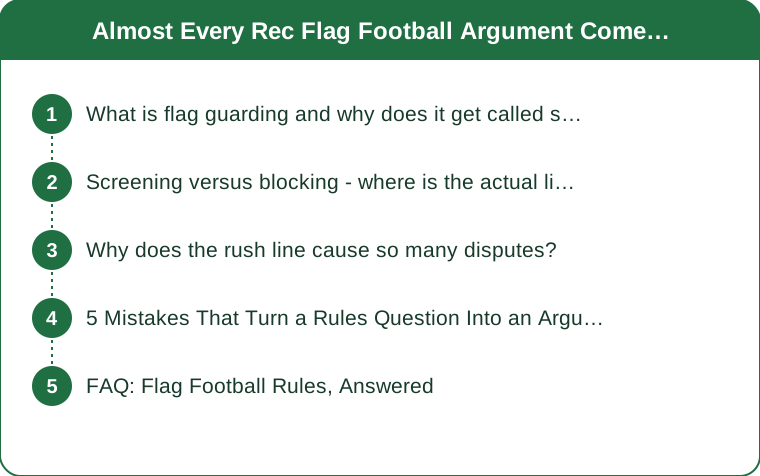
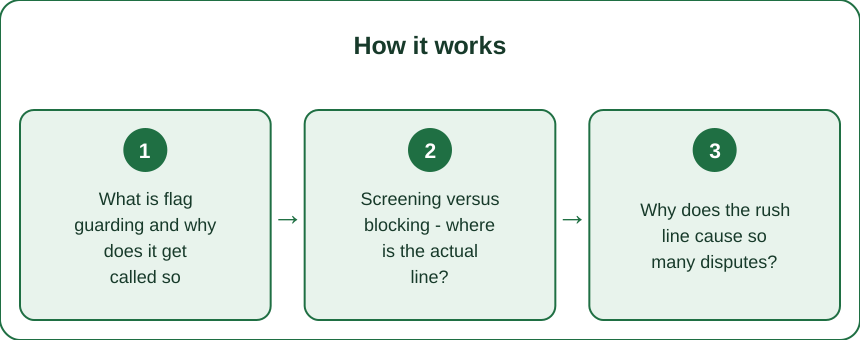
What is flag guarding and why does it get called so inconsistently?
Flag guarding is any deliberate action that stops a defender reaching your flag. Swatting a hand down, dropping an elbow, spinning so the ball covers the belt, or lowering a shoulder over the flag - all of it is the same infraction.
The reason it is contentious is that it looks identical to normal running. Arms move when you sprint. A ball carried low sits near the belt line. The referee is judging intent from a metre away while both players are moving, which is why two officials will call the same play differently.
The practical test most leagues use is whether the arm made contact with the defender’s hand or came down specifically as the reach happened. Natural arm swing during a stride is legal. A downward chop timed to the reach is not.
The penalty is usually significant - commonly a loss of yards from the spot and a dead ball, which is why it decides games rather than just annoying people.
How to stop giving it away: carry the ball high, at chest height, in the hand away from the nearest defender. Ball-low running invites both the call and the accidental contact that triggers it.
And if you are on defence, reach across the front of the belt rather than from behind. Reaching from behind puts your hand exactly where a natural arm swing lands, which is how clean pulls get argued into penalties.
Screening versus blocking - where is the actual line?
Most flag rule sets ban blocking entirely and permit screening. The difference is whether you initiate contact and whether your arms are extended.
A legal screen is a stationary or moving body in the defender’s path with arms in or crossed over the chest. You may occupy space. You may not deliver force into someone.
Illegal blocking is any extension - arms out, hands on the defender, a step into them, or a shoulder driven forward. The moment you push, it is a foul regardless of how minor.
The awkward middle case is the moving screen, where you drift into a rusher’s lane as they accelerate. Some leagues treat this as legal obstruction, others require the screener to be set. This is one of the biggest rule-set differences and it is worth asking about specifically before week one.
For receivers, the equivalent problem is the pick play. Two receivers crossing so one incidentally obstructs a defender is legal in most rec rules. Running directly at a defender to obstruct them is not, and the distinction is whether you were running a route or running at a person.
The practical version: if you can honestly say you were going somewhere and they ran into you, you are usually fine. If you went to where they were, you are usually not.

Why does the rush line cause so many disputes?
Most rec leagues set a rush line - commonly seven yards off the line of scrimmage - that pass rushers must start behind. Anyone rushing must be behind that marker when the ball is snapped.
The problems are that the marker is often invisible. Cones drift, fields have no seven-yard reference, and a rusher who paces it off before the snap will disagree with the offence about where the line was.
The second problem is timing rather than position. A rusher who is behind the line but starts moving before the snap arrives faster than the rule intends, and the offence experiences that as cheating even when the starting position was legal.
Non-rushers have restrictions too. In most rule sets, defenders who did not start behind the rush line cannot cross the line of scrimmage until the ball leaves the quarterback’s hand or is handed off.
The fix is boring and it works: put down a cone at the rush line before the game and point at it during the pre-game chat. Ninety seconds of agreement prevents an hour of arguing.
For quarterbacks: if a rusher is consistently arriving early, count the rush aloud once. It flags the problem to everyone without turning it into an accusation, and it usually resolves itself immediately.
5 Mistakes That Turn a Rules Question Into an Argument
Mistake 1: Debating during the play clock. Nobody resolves anything with fourteen people standing around and a game to finish. Flag it, play on, and settle it between drives.
Mistake 2: Assuming the rules you learned are the rules being used. There are several major flag football rule sets and they differ on rushing distance, blocking, and whether the quarterback can run. Your correct memory of a different rule set is still wrong here.
Mistake 3: Arguing the call rather than the rule. Officials will not reverse a judgement, but they will happily clarify what standard they are applying, which is far more useful for the next forty minutes.
Mistake 4: Letting the loudest player be the rules authority. Confidence is not knowledge. Ask whoever brought the league rule sheet, and if nobody brought it, that is your actual problem.
Mistake 5: Not agreeing the ambiguous points before kickoff. Rush distance, whether the quarterback can run, and what happens on a dropped snap take two minutes to settle beforehand and ruin games when they are not.
The one nobody expects is the second. Experienced players import rules from a previous league with total confidence, and being experienced makes them harder to correct.
FAQ: Flag Football Rules, Answered
What exactly counts as flag guarding?
Any deliberate action that prevents a defender from reaching your flag - swatting the hand away, dropping an elbow over the belt, or covering the flag with the ball. Natural arm swing while running is legal; a downward motion timed to the reach is not.
Can you block in flag football?
In most rule sets, no. You can screen - occupying space with your body, arms in - but you cannot extend your arms, push, or initiate contact. Any extension is generally a foul.
How far back does a pass rusher have to start?
Commonly seven yards, but it varies by league. Put a cone down before the game and confirm it during the pre-game chat, because the disagreement is almost always about where the line was rather than the rule itself.
Are pick plays legal in flag football?
Crossing routes where a defender is incidentally obstructed are usually legal. Running deliberately at a defender to obstruct them is not. The test is whether you were running a route or running at a person.
What should we settle before the first game?
Rush distance, whether the quarterback can run, blocking and screening standards, and what happens on a dropped snap. Two minutes beforehand saves the whole season.
TL;DR:
- Flag guarding, screening versus blocking, and the rush line account for nearly every rec league argument.
- Carry the ball high and away from the nearest defender to stop giving away flag guarding calls.
- Screening means occupying space with arms in; any extension or push is a foul in most rule sets.
- Put a cone at the rush line before kickoff - the dispute is almost always about position, not the rule.
- Settle rush distance, quarterback running, and dropped snaps in the pre-game chat, and never debate during the play clock.
The team that read the rule sheet wins about two extra possessions a season without getting any better at football.
Keep Reading
This article is for general informational and styling purposes only. Fit, sizing, and product availability may vary.