Why Flag Pulls Miss Even When Your Angle and Timing Look Right
Quick Answer: Most missed flag pulls that look technically correct come down to grabbing at the runner’s hip position at the moment of reach rather than where the hip will be a fraction of a second later — closing the timing gap between reach and grab, not the angle of approach, is what actually fixes it.
It’s a frustrating pattern because the breakdown happens in a fraction of a second that’s hard to self-diagnose without seeing it slowed down.

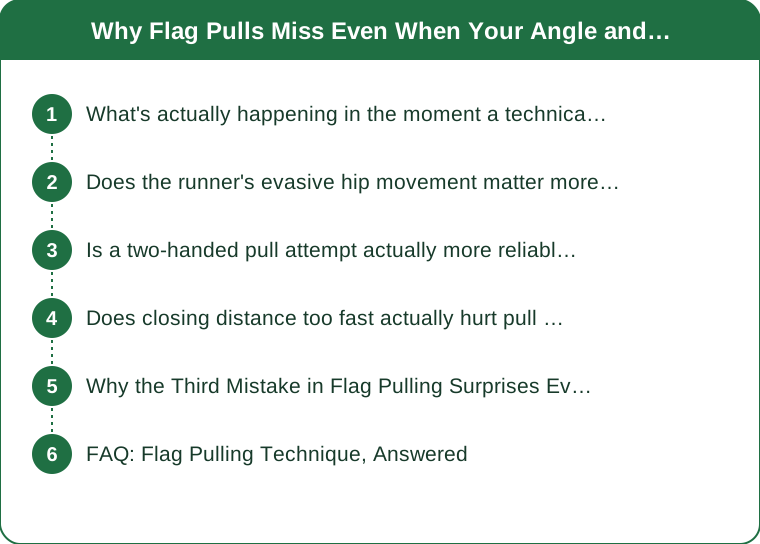
What’s actually happening in the moment a technically good-looking pull still misses?
The defender’s hand is generally aimed at where the flag is at the moment the reach begins, but a moving runner’s hip continues shifting during the roughly 0.2-0.3 seconds the hand takes to travel — aiming at the current position rather than slightly ahead of it is the core mechanical miss, even when the overall angle and closing speed look correct.
Does the runner’s evasive hip movement matter more than straight-line speed?
Often yes — a runner making a subtle lateral hip fake specifically to disrupt flag-pull timing is a common and effective evasive technique, and it’s specifically designed to exploit the reach-timing gap described above rather than to simply outrun a defender.
Is a two-handed pull attempt actually more reliable than a one-handed reach?
Generally yes for accuracy, though it costs a small amount of reach distance — a two-handed approach gives a wider net for the same timing window, meaningfully increasing the odds of contacting the flag even if the primary hand’s timing is slightly off.

Does closing distance too fast actually hurt pull accuracy?
Yes — closing too aggressively reduces the reaction window available to adjust to a late direction change, meaning a defender who closes distance a bit more under control, with a slightly wider base, often has a better success rate than one sprinting in at full speed and reaching from an unstable position.
Why the Third Mistake in Flag Pulling Surprises Even Experienced Players
Most flag football coaching focuses on angle of approach and closing speed, which are real factors but not usually the actual miss point for players who already look technically sound. The timing gap between reach and grab is rarely coached explicitly because it’s hard to see without slow-motion video — which is exactly why experienced players are sometimes surprised, on reviewing their own film, that their miss pattern traces back to grabbing at a position the runner had already left, not to a bad angle at all.
FAQ: Flag Pulling Technique, Answered
Does practicing against a stationary target actually help with this timing issue?
Only partially — stationary target practice builds hand-eye coordination and reach mechanics, but the specific reach-timing gap only shows up against a moving, evasive target, so live reps matter more for this particular fix.
Should a defender aim for the flag itself or the runner’s hip generally?
Aiming slightly ahead of the current hip position, anticipating the next quarter-second of movement, tends to outperform aiming directly at either the flag or the current hip position.
Is lowering your center of gravity before the reach actually useful?
Yes — a lower, more stable base at the moment of reach allows a faster last-instant adjustment if the runner shifts direction, compared to reaching from a higher, less stable position.
TL;DR:
- Most clean-looking missed pulls come down to a timing gap, not a bad angle
- Runners exploit this gap deliberately with subtle hip fakes
- A two-handed reach widens the effective timing window for the same attempt
- Closing distance under control, with a stable base, beats closing at full uncontrolled speed
The angle was never the problem — the hand just needed to aim slightly ahead, not at where the flag already was.
Keep Reading
This article is for general informational and styling purposes only. Fit, sizing, and product availability may vary.