Why You Drop Catches When the Sun Sits Low in the Sky
Quick Answer: Low sun costs you catches through three separate mechanisms, not one: direct glare washing out contrast, pupil constriction that makes shaded areas of the field temporarily unreadable, and a longer, flatter shadow field that hides the ball against the ground on low throws. The fixes are positional rather than technical - change your release angle so the route breaks across the sun rather than into it, track with peripheral vision rather than looking straight at it, and call for the ball earlier so the quarterback throws to a spot instead of to you.
From late August the sun drops noticeably earlier each week, and evening league games move from being played in full daylight to being played into a low sun within about a month. The drops that follow are almost always blamed on hands.

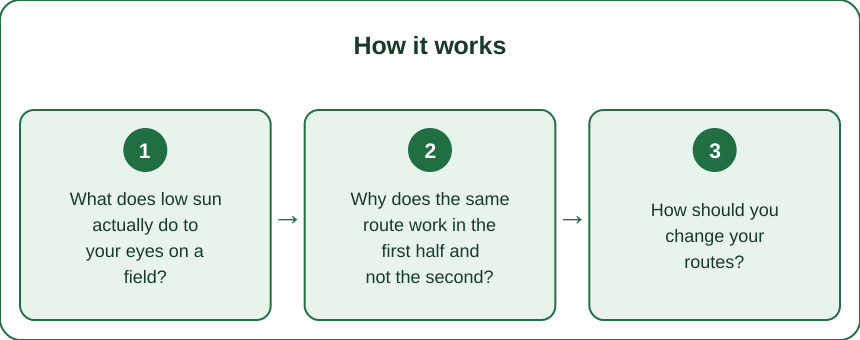
What does low sun actually do to your eyes on a field?
Three things, and understanding them separately is what makes the fixes obvious.
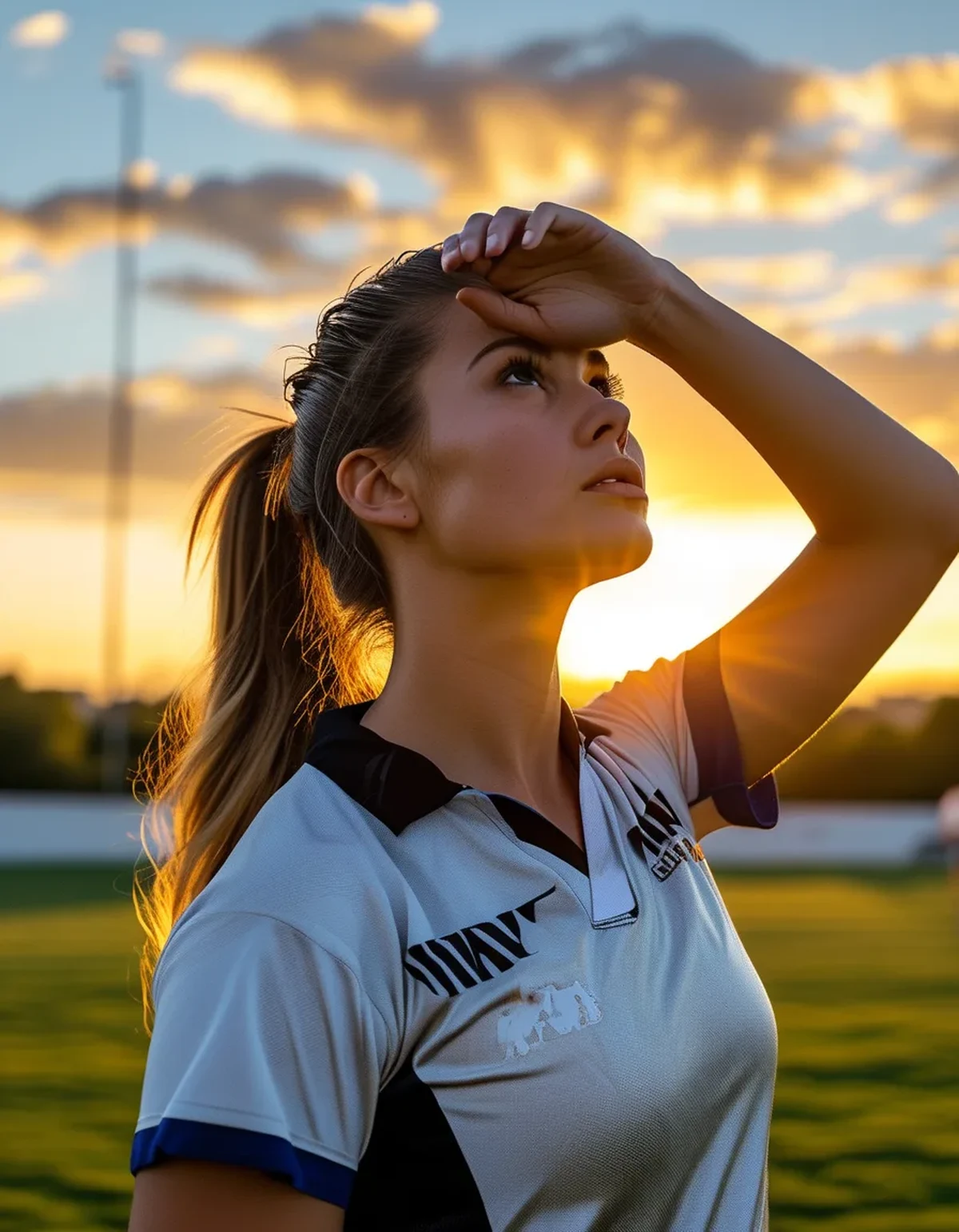
Contrast collapses. A ball against a bright sky is a dark object against a light background - easy. A ball crossing directly in front of a low sun is a dark object against an extremely bright background, and your eye simply cannot resolve the edges. This is not about squinting harder; the information is not reaching you.
Your pupils constrict, and stay constricted. Looking toward a bright sun makes the pupil close down within a fraction of a second. Reopening takes considerably longer. So a receiver who glances toward the sun and then looks into a shaded part of the field is temporarily half-blind in the shade for a second or two - which is exactly the duration of a route.
The shadow field changes. With the sun at 10 degrees above the horizon instead of 50, shadows are long, dark, and horizontal. A low throw travelling through the shadow of a treeline or a stand disappears against a dark background at exactly the moment you need to pick it up.
Why does the same route work in the first half and not the second?
Because the sun moves, and the field does not.
In the last hour before sunset the sun drops roughly 10-12 degrees, which is a large change at that end of the arc. A route that was catching the ball against a bright but clear sky at 6:30pm is catching it directly across the sun at 7:15pm.
The direction of play matters more than the time. In a game where you switch ends at half time, the receiver who was fine in the first half is the one dropping in the second, and vice versa. This is completely predictable and almost nobody plans for it.
What to do about it: at the start of the second half, stand where you will be running and look up where the ball will come from. Ten seconds. You will know immediately whether your side of the field has a problem, and you can tell your quarterback before the first drive rather than after the first drop.
The teams that handle this well treat it like wind - a known condition to be planned around at the change of ends, not a surprise that gets discovered on third down.
How should you change your routes?
The best answer is geometric: change where the ball arrives relative to the sun, not how you catch it.
Break across the sun, not into it. A route that finishes with you running toward the sun means every ball comes from behind you into the brightest part of the sky. The same route mirrored to the other side of the field puts the sun over your shoulder and the problem disappears entirely.
Favour in-breaking routes on the sun side. Slants, drags, and digs bring you back toward the middle, where the ball arrives from a lower and less problematic angle.
Avoid deep balls into the sun. A go route or a corner into a low sun is the highest-difficulty catch in the game, and the ball is in the air longest. Run those on the shaded side and use the sun side for short, quick, low-arc throws where the ball never gets high enough to cross the sun.
Tell the quarterback which shoulder. If you know the ball has to come to your left shoulder because your right is into the light, say so in the huddle. This is a normal, useful piece of information and most recreational teams never share it.
5 Mistakes Everyone Makes in Low Sun
1. Staring at the release. Watching the ball leave the quarterback’s hand means looking directly at the brightest part of the field. Track it with peripheral vision for the first half of its flight and pick it up properly as it descends out of the bright zone.
2. Using a hand as a shield too late. The shield has to be up before the ball is in the air. Raising a hand while tracking costs you a hand for the catch and arrives too late to protect your pupils.
3. Wearing dark sunglasses. Counterintuitive, but heavy dark lenses make the shaded parts of the field much harder to read, and the shadow problem is half the issue. A light amber or rose tint improves contrast without killing your ability to see into shadow. Many players do better with a cap peak alone than with sunglasses.
4. Not swapping sides. If your team has a receiver who wears contacts, is light-sensitive, or simply struggles with glare, put them on the shaded side. This is free and almost nobody does it.
5. Blaming the hands. A drop caused by not seeing the ball is a visibility problem, and drilling catches at Tuesday practice in flat afternoon light will not fix it. Practise catching into a low sun deliberately, once, and it stops being a surprise.
Does anything actually help you see better?
A few things, in rough order of how much difference they make.
A cap with a dark under-peak. This is the highest-value item and it costs almost nothing. The peak blocks direct sun and the dark underside stops light bouncing back up into your eyes from the brim. Matte black under-peak, not white.
Amber or rose lenses. These filter blue light and increase contrast, which is exactly the deficit low sun creates. They work markedly better than grey or dark lenses for ball tracking. Fit matters - anything that slides during a cut is a net loss.
Eye black. It is not a superstition. Reducing reflection from the skin under the eye produces a small but measurable improvement in contrast sensitivity in bright conditions.
Give your eyes twenty seconds before the drive. Looking at a mid-brightness part of the sky rather than at the ground or at the sun lets your pupils settle at a useful middle setting.
What does not help: squinting harder, staring at the sun to get used to it, or any of the folk remedies around adjusting. Do not look directly at the sun to acclimatise - that is genuinely harmful and it does not work.
FAQ: Low Sun and Catching, Answered
Should the quarterback throw differently?
Yes. Flatter and earlier on the sun side. A high arcing ball spends longer in the bright zone; a low, hard throw crosses it quickly and arrives below the glare.
Does this affect defenders too?
More than receivers, usually, because defenders are often looking back into the sun to track the ball while running backwards. It is a genuine advantage for the offense on the sun side, and worth exploiting rather than avoiding.
What about floodlights?
Same principle, different geometry. Floodlights create fixed bright zones and hard shadow edges rather than a moving one. The advantage is that it does not change during the game, so one look at warm-up tells you everything.
Is there a time of year this is worst?
Late August through October for evening leagues, because sunset time is moving fastest and it lands right in the middle of a typical fixture slot.
TL;DR:
- Low sun costs catches through glare, pupil constriction, and long shadows - three problems, not one.
- Break across the sun, not into it, and keep deep routes on the shaded side.
- Track with peripheral vision early in the flight, and get the shielding hand up before the throw.
- A cap with a matte dark under-peak beats sunglasses; if you wear lenses, choose amber or rose.
- Check your side at the change of ends - ten seconds, and it turns a surprise into a plan.
Almost nobody drops a ball they saw clearly. Fix the seeing and the hands were never the problem.
Keep Reading
This article is for general informational and styling purposes only. Fit, sizing, and product availability may vary.